
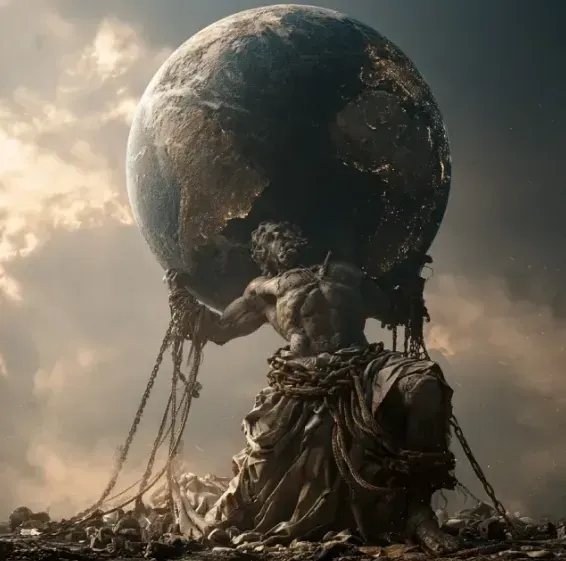
On Atlas, the heavens he was condemned to carry, and a civilisation that has confused the world with the sky.
Who is John Galt? Who is he, I hear you say. What does it even mean? No — we are not embarking on an LSD trip or an ayahuasca ride, surfing and skimming the edges of consciousness. We are not conjuring some evil spirit, some ectoplasm summoned at a Victorian séance in the desperate hope that answers to our Western malaise might be unveiled from another dimension. We do, however, wear the very same quizzical look that Ayn Rand’s characters wore. No? Still not with me?
The connection ought to be immediate. For we have our own real-world Titan — three thousand years of Western civilisation, today mostly encased within the ecosystem of the European Union — and, just as in the novel, our Titan is weary of carrying the world upon his shoulders. Blinded to any meaningful direction by the self-imposed equality-of-outcome virus, his feet bound by a thousand ropes of regulation that restrict his very breathing, his liberty of expression stripped from him, the only motion left to him is the shrug.
And here is the first thing the erudite reader already suspects and the careless one has never troubled to learn: Atlas never carried the world. The convenient image — the muscled giant hunched beneath a terrestrial globe — is a Renaissance misreading, a cartographer’s conceit later borrowed to adorn the frontispiece of an atlas, the very word we owe to him. The Atlas of the Greeks, condemned by Zeus after the Titanomachy to stand at the western verge of the earth, bore not the world but the ouranos: the heavens, the vault of the fixed stars, the whole ordered canopy of meaning that hangs above the mud. His sentence was not to carry matter. It was to hold up the sky — to keep the higher order from crashing down upon the lower.
Hold that correction close, for it is the whole of my argument in miniature. Our civilisation imagines its burden to be material — competitiveness, output, the grubby arithmetic of gross domestic product — and so it reaches, panting, for material remedies. But the weight actually slipping from its shoulders is the ouranos: the canopy of meaning, the metaphysical why beneath which alone the material labour makes any sense at all. Europe believes it has an economics problem. It has a heavens problem. And a Titan who has forgotten that he was set to hold up the sky, and imagines instead that he is merely hauling a heavy world he never agreed to carry, will do the one thing left to a creature who can no longer see the point of his own strength.
He will shrug.
* * *
Rand understood the mechanism better than her detractors will allow, even where she flattened it into melodrama. In her world innovation is no hobby and no line item; it is the motor of the world, and the men and women of the mind are the unacknowledged Atlantes upon whom the whole edifice silently rests. Her cruellest insight was not that the looters loot — that is trivial, and eternal — but that the producers consent to it. The sanction of the victim, she called it: the quiet moral permission the competent extend to those who despise them, the endless willingness to keep the engine turning for the benefit of people who have already declared the engine a sin. Galt’s strike is nothing grander than the withdrawal of that sanction. He does not storm the citadel. He simply stops apologising for being able to build it.
And building, in our century, is power in its rawest geopolitical form. Whoever commands the frontier — the silicon, the models, the reactors, the rockets, the compounds that cure and the code that governs — commands the age. Nations that innovate write the rules that others must inhabit; nations that merely regulate take up residence, as lodgers, in a house designed elsewhere. This is not ideology; it is the plainest fact of the era. And Europe, which once furnished the world with very nearly every idea worth regulating, has quietly resolved to become its most exquisitely appointed lodger.
For regulation, rightly understood, is a fence around a cliff — the humane and rational act of a civilisation that wishes its children to run freely and not to fall. Regulation for regulation’s own sake is something else entirely: a fence in the middle of a level field, then a fence around that fence, then a licensing regime for the surveyor engaged to measure the gap between them, and then an ethics board convened to review the surveyor. It is not caution; caution has an object. It is displacement activity dressed in the vestments of virtue — the busywork of a culture that has lost the nerve to build and has learned, in its place, to find in the paperwork of building a substitute for the vanished thing itself. One requires no courage to file a form. That is rather the point of the form.
You need not take my word for any of it. Take the word of the ultimate insider. In September of 2024, Mario Draghi — “whatever it takes” Draghi, the central banker’s central banker, a man who has spent a lifetime as the very marrow of the European establishment — laid before Brussels a three-hundred-and-eighty-three-page autopsy of the still-breathing. The Future of European Competitiveness reads, in its flat clinical prose, like a physician reciting a terminal diagnosis to a patient who has not yet noticed the symptoms: growth stalled, productivity flat, the continent falling ever further behind both America and China, its innovators garrotted by a lattice of some hundred technology-specific laws and enforced by upward of two hundred and seventy separate regulators. His prescription carried a price of roughly eight hundred billion euros a year. The establishment’s own high priest had, at long last, confessed the sin from the very altar.
* * *
So: is Draghi John Galt?
It is tempting — very tempting — to answer yes. Here, surely, is the competent man at last striking his fist upon the glass, the one who knows precisely how the engine was built standing over its seized and smoking ruin and refusing, alone among the courtiers, to pretend the smoke is merely fog. Read the report as a cri de coeur and Draghi becomes Galt in Savile Row: the producer who can no longer stomach the studied incompetence of the looters and says so, aloud, in the one dialect Brussels cannot pretend not to understand — that of the balance sheet. There is real courage in a creature of the system naming aloud the disease of the system. Grant him that; he has earned it.
And yet.
John Galt did not write a report. That is the entire point of him — the axis upon which Rand’s thousand-page cathedral turns. Galt withdrew. He gathered the men of the mind and led them out of the world and let the looters’ paradise collapse beneath the accumulated weight of its own good intentions, and he accomplished it by the single most radical act available to the competent: refusal. He did not petition the machine to reform itself. He switched it off and walked into the mountains, and he did not glance back to watch it fall.
Draghi did the precise opposite. Confronted with strangulation, he prescribed not fewer hands upon the throat but more — better coordinated, more rational, more European hands: eight hundred billion euros of pooled investment, a completed Capital Markets Union, a twenty-eighth legal regime laid over the twenty-seven, the abolition of national vetoes so that the great plan might at last proceed at the velocity its planners feel they deserve. It is the technocrat’s eternal and almost touching faith: that the plan was never the problem, only that the plan had been insufficiently grand. That is not a strike. It is a memorandum, followed with all deliberate speed by a committee to implement the memorandum.
He is, in truth, less John Galt than Dostoevsky’s Grand Inquisitor — the old cardinal who meets the returned Christ in the streets of Seville and explains to him, wearily and not without a terrible tenderness, why he must be sent away again. Men cannot bear the burden of freedom, the Inquisitor says; it is too heavy for them; and so the Church has mercifully lifted it from their shoulders and given them, in exchange, bread — and miracle, and mystery, and authority — and they are content in their servitude, more content than freedom ever made them. Draghi is that man in a different vestment. He has seen the truth — has set it down, indeed, across three hundred and eighty-three pages of it — and has concluded, with a paternalism far too gentle to recognise itself as such, that the continent cannot be trusted with the wild, unbound liberty that alone might save it, and must instead be administered toward its salvation by wiser hands. The tragedy of Draghi is not that he is a fool. It is that he is far too intelligent to be one, and cannot bring himself to name the true cause of the disease, because the true cause is the very machine he has served his whole life long, and to name it would be to indict himself.
Observe, if you require the proof, what Europe actually did the instant it conceded that he was right. It resolved, with great solemnity, to deregulate — and it did so by drafting a fresh regulation to simplify the existing regulations. The “Digital Omnibus,” they christened it; proposed in November of 2025, negotiated across the better part of two years, promising to lighten the administrative burden by a quarter (a third, for the smallest firms) by the year 2029, and grinding at last into force in 2026 alongside the very artificial-intelligence rulebook it had been convened to amend before that rulebook’s ink was even dry. This is a continent that cannot loosen a single rope except by first tying a new and more intricate knot. Asked, like Atlas, merely to shrug, it convened instead a working group to study the ergonomics of shrugging, commissioned an impact assessment, and pencilled the shrug in for the next legislative cycle.
So: no. Draghi is not John Galt. Draghi is the answer the report was written precisely in order not to give.
* * *
But here the blunt libertarian anthem — unbind the Titan, strike every fetter, let the innovators run — collides with a wall it would very much prefer not to see, and honesty requires that we walk directly into it. For innovation, unleashed, is not automatically good. It is not even, in the final analysis, neutral. And to grasp why, I ask you to set two men side by side.
The first is Geoffrey Pyke. English, self-taught, gloriously and incorrigibly eccentric; a man who escaped a German internment camp in the first war and walked a hundred miles to the Dutch frontier on the reasoning that the border would be watched least where escape seemed most absurd; who founded an experimental school; and who in the second war proposed — I promise you I am not inventing this — to construct an aircraft carrier out of reinforced ice, a compound of frozen water and wood pulp he christened pykrete, in order to close the mid-Atlantic air gap against the U-boats. Half of what he dreamed was unbuildable. The other half was merely ahead of its hour. But every last particle of it was bent toward one end: the defeat of fascism and the relief of human suffering, pursued with a schoolboy’s delight in the puzzle and a grown man’s horror of the alternative.
The second is Hans Kammler. German, a doctorate in engineering, brilliant, efficient, and cold as the vacuum his rockets would one day reach. An SS officer who administered the construction — mark well that antiseptic word — of the machinery of Auschwitz, the crematoria and the chambers; and who then rose to command the V-2 programme: a genuine and undeniable marvel of human ingenuity, the first object our species ever flung past the edge of the atmosphere and into space, assembled in a tunnel by slaves worked to death in their thousands and aimed, when complete, at the sleeping cities of his enemies.
Two engineers. The same decade, the same wounded continent, comparable gifts. And the very rocket that carried Kammler’s terror is the direct technical ancestor of the one that, two decades on, would carry men to the surface of the Moon — the same lineage of thrust and guidance, some of the very same hands, refined from massacre into transcendence. The metal does not know which it is. The equation does not care. The V-2 is idea-agnostic; the men who conceive it, fund it, build it, and aim it are not, and never can be.
This is the truth that the innovation-worshipper and the innovation-scold conspire, each for his own reasons, to avoid: no technology is idea-agnostic, because no technology chooses its own master. Heidegger — and one must swallow one’s considerable reservations about the man to take the point, of which more in a moment — saw to the very bottom of this in his essay on the question concerning technology. The essence of technology, he argued, is nothing itself technological. Modern technology is a mode of revealing, a way of compelling the world to show itself; and the manner in which it compels the world to show itself is as Gestell — enframing — an endless standing-reserve of resource awaiting extraction, optimisation, order. The river is revealed as a supplier of hydroelectric power; the forest as so many board-feet; and — this is Kammler’s contribution to the argument — the human being as a unit of labour to be consumed in the tunnel. The Greeks knew techne as a sister of poiesis, a bringing-forth braided together with the true and the beautiful. We have severed it from both, and are then astonished to discover that it will serve any master who consents to feed it.
And here is the irony the erudite reader will already have felt approaching, and which I will not insult you by softening: the philosopher who diagnosed the soul-flattening essence of technology more profoundly than any other was himself a member of the Party that perfected its application — he assumed the rectorship, mouthed the slogans, and never adequately recanted. The thinker and the engineer, the diagnosis and the disease, lodged together within the same catastrophe. If you require a single proof that no approach to innovation is ever idea-agnostic — that the philosophy always precedes the machine and silently steers it — there it stands: even the man who understood the machine’s danger most deeply could be captured by the idea that aimed it.
Europe has spent two decades interrogating innovation with only two questions — how much, and how fast — and answering both, reflexively, with less and slower. It has entirely forgotten the third question, the only one that finally signifies: toward what, and in whose name, and why. That is the deeper sickness, and it is the ouranos once again. The Titan is bound, yes; but graver than his bondage is this — that were we to sever every rope tomorrow, he would stand there blinking, uncertain what to reach for, because he can no longer remember what he was set to hold the sky up for.
Who is John Galt?
Which brings us, as everything in this territory eventually must, to the man with the hammer.
Nietzsche did not predict our malaise; he diagnosed it in advance, with a precision that reads today less like philosophy than like clairvoyance. When his madman came running into the marketplace crying that God is dead, and that it is we who have killed him, the shallow heard mere atheism and passed on. What Nietzsche meant was immeasurably graver: that the entire metaphysical scaffolding upon which the West had hung its every value — its good and its evil, its higher and its lower, its very conviction that some lives and some deeds weigh more than others — had quietly rotted through, and that we had not yet begun to feel the vertigo of standing above the void where the floor had been. Every symptom I have named in this essay is a tremor of that one collapse.
The equality-of-outcome virus is, in his unforgiving vocabulary, the triumph of ressentiment — the slow, patient, centuries-long revolt of the herd, which, unable to rise to the strength it envies, performs instead a breathtaking alchemy: it pronounces its own weakness a virtue and the strength of the strong a sin, and christens the whole inversion justice. The Genealogy of Morals is nothing less than the forensic reconstruction of that revolt, and one need only read a single week of our contemporary discourse to watch it running yet, unbroken, and more confident than ever it was. Levelling is baptised as fairness. Mediocrity is awarded the moral prestige once reserved for excellence. And presiding over the whole comfortable, centrally-heated arrangement squats the figure Nietzsche despised above all others: the Last Man — the small, blinking creature who has “invented happiness,” who has abolished danger and striving and every overreaching of the human toward the more-than-human, and who now wants nothing but warmth, and safety, and the frictionless satisfaction of his modest daily appetites. The precautionary principle is no mere regulatory doctrine. It is the Last Man’s entire philosophy of existence, engrossed upon vellum and enacted into statute. Above all, no risk. Nietzsche would gaze upon a continent that harmonises and mitigates and pre-empts its way around every last possibility of greatness, and he would say, very quietly: behold, the herd has built itself a parliament, and furnished it beautifully.
But — and here the honest essayist must forgo the easy applause of half his readers — Nietzsche would spare no one in that parliament, and least of all the innovators who fancy themselves his heirs. He was no cheerful chaplain of Silicon Valley. The very Last Man he dreaded is to be found not only among the levellers but among the builders; for the Last Man is the terminus of any life whatever that is organised around comfort and novelty, and a vast proportion of what we now so grandly style innovationis precisely that and nothing further: the frictionless engineering of ever-smaller pleasures, the industrial mining of human attention, cleverness of the very highest order expended in the total absence of any project that could dignify it. Technology divorced from an ascending purpose is not the cure for the nihilism Nietzsche foresaw. It is that same nihilism accelerated, and better tooled — Kammler’s cold efficiency with a lanyard and a mission statement. His will to power was never the vulgar thing his enemies pretend; it was the imposition of form upon chaos, the self-overcoming by which a being becomes the author of its own values rather than the mere inheritor of another’s. An innovation that creates nothing beyond an uptick in engagement would have drawn from him exactly the contempt he reserved for the bureaucrat’s rulebook. Both are the productions of men who have ceased to create anything that matters.
And what, then, of the postmodern turn, and of its late and quarrelsome child that we now so clumsily call wokeism? Here we must be exact, because the lineage is real, and it is genuinely uncomfortable, and it runs directly through the man with the hammer. Foucault lifted his genealogical method wholesale from Nietzsche — the unmasking of every claim to truth as a mask worn by power. Lyotard distilled the entire age into a single phrase: an incredulity toward metanarratives. Derrida taught a generation to deconstruct, to hunt out the buried hierarchy in every text and gleefully to invert it. All of it, every last move, Nietzschean in its instrument. But they inherited only the hammer, and never the hand that was meant to wield it.
For Nietzsche shattered the idols to clear the ground — to make room for the creation of new values, higher types, a future that might justify the demolition. Beneath all the dynamite he was a builder; his no stood always in the service of a greater yes. His heirs kept the shattering and quietly abandoned the building. Deconstruction arrived, and no cathedral ever followed it; critique hardened into a permanent condition, a professional posture, suspicion elevated into an entire and self-perpetuating career. And when one weds that purely negative genealogical reflex to the ressentimentNietzsche had already anatomised — the moral authority of the wound, the prestige of grievance, the deep instinct to drag down whatever dares to rise — one obtains a machine of extraordinary efficiency, tuned to a single office: the delegitimising of excellence, of hierarchy, of achievement, of the canon, of the Titan himself, all of it toppled in the name of precisely nothing that anyone present can name. It is superb, this machine, at pulling down the statues. It has never once troubled to say what it proposes to raise in their place — because it has, in the deepest sense, nothing whatever to propose. It kept Nietzsche’s hammer and flung away his blueprint, and now it wanders the ruins of its own making, mistaking demolition for construction and calling the rubble progress.
Let me be scrupulous, since we are among the uncompromising: Nietzsche would have extended no more patience to the reactionary who merely wishes to embalm the past, nor to the technologist who mistakes disruption for value, than to the leveller. His fire was reserved, with perfect consistency, for anyone at all who had ceased to create. And by that exacting measure our age fails from every direction at once — the levellers, who create nothing but ever more elaborate permission-structures for their own resentment; the builders, who create marvels in the service of no idea larger than a quarterly return; and the deconstructors, who create nothing whatsoever and have contrived to make a virtue of the fact. The herd, and the last engineer, and the professional iconoclast, glaring at one another across an exhausted continent, and not one of the three able to say what any of it is finally for.
Who is John Galt?
So. Who is he, in the end?
He is the question a civilisation puts to itself when it can no longer remember the answer. He is what remains when the men of the mind are punished for the crime of possessing minds; when the sole reward for building is a licence to build, countersigned in triplicate; when the highest virtue a culture can any longer conceive is the equal distribution of a visibly shrinking pie. He is not, in the last analysis, a person at all. He is an absence — the precise shape of the thing we have exiled, cut cleanly out of the world we chose to keep.
Our Titan is not weak. Let no one persuade you otherwise. He is the strongest thing that three thousand years of striving ever produced, and the ropes that bind him are, every last one of them, of his own manufacture and his own knotting. Those we can cut; and Draghi, to his lasting credit, has at least walked the perimeter and located the knots, even as he flinched from the blade. But the ropes were never the deepest trouble. The blindfold is the deeper trouble — the not-knowing, the vertigo above the void where the metaphysical floor once lay, the terrible unspoken suspicion, creeping now through the whole of the West, that the sky above him may no longer be worth the agony of holding up. And that is the one thing no omnibus will ever legislate and no eight hundred billion euros will ever purchase: a reason to lift. A whylarge enough that the innovation serves it rather than replacing it; a canopy of value grown confident enough, at last, to instruct the multiplier in what to multiply, and to aim it at something nobler than our own comfort or our own resentment.
Give Atlas back the heavens — the true burden, the ouranos, the ordered sky of meaning he was always set to bear — and he will square his shoulders and hold up the whole material world besides as a mere afterthought, gladly, as he did for three thousand years before we took it upon ourselves to inform him that his strength was a sin. Leave him blindfolded beneath a weight we have taught him to resent and can no longer ourselves explain, and he will go on doing the only thing that remains to a bound and blinded giant who has lost all memory of why he was ever set to stand there at all.
He shrugs.
Who is John Galt?