

Welcome to the Matrix, Updated
“In the beginning was the Word. And then the Word was weaponised.”
You were born into a story. Not a neutral one—not some bland tapestry of facts and dates and things that “just happened.” No. You were born into a carefully crafted, continuously updated narrative environment. The air you breathe isn’t just full of oxygen—it’s thick with meanings you didn’t choose and symbols you didn’t invent. Welcome to the Matrix. Not the science fiction one, but the real one: the one built not by machines, but by institutions, algorithms, journalists, NGOs, and the polished smiles of TED Talk messiahs.
We like to pretend we’re free thinkers, especially in the West. We imagine ourselves above propaganda. That’s for North Korea. For the rubes. For the brainwashed. We don’t see the strings because they’re tastefully designed. They don’t come in jackboots—they come in press releases, influencer collaborations, and ESG scoring rubrics. And instead of a Ministry of Truth, we have partnerships with Meta, Oxford's Internet Institute, and the Ford Foundation.
This is the Narrative Industrial Complex—a sprawling, decentralised, self-reinforcing system of belief production. It doesn’t need to coerce you. That’s the old model. This one nudges you, flatters you, follows your preferences, and tells you it’s all your idea. You’ll even thank it for the illusion of choice.
Let’s drop the nostalgia. The old world—the one where reality was messy, where people argued in good faith, where journalists uncovered stories rather than choreographed them—that world is dead. Or at least comatose. What replaced it is a sleek, data-driven spectacle, run by behavioural psychologists, media foundations, risk consultants, and a legion of true believers with graduate degrees in outrage. They call it “impact.” You call it “the truth.” I call it narrative supply chain management.
Events don’t matter. Interpretation does. A riot can be a protest. A protest can be a threat to democracy. A drone strike can be a humanitarian intervention. A whistleblower can be a traitor or a hero—depending on whether their revelations serve the dominant frame. Everything is fungible in the narrative economy.
And who manages this economy?
It’s not just states anymore. The players have multiplied and morphed. Tech platforms algorithmically boost what aligns with approved scripts. Think tanks draft the language that becomes law. Intelligence services leak selectively to shape the Overton Window. Universities produce the moral language. NGOs act as laundering machines, translating geopolitical interest into digestible humanitarian campaigns. And the media—bless them—play stenographer to it all, grinning behind the guise of “fact-checking.”
Eisenhower warned of the Military-Industrial Complex. He imagined generals and arms dealers carving up the future over whisky and blueprints. But he missed the next evolution—the version that trades not in missiles but in meanings.
What’s most sinister is that there is no single villain. This isn’t some Bond-villain cabal stroking white cats in Davos. It’s worse: it’s systemic. Everyone believes they’re doing good. Everyone thinks they’re defending truth, protecting democracy, saving lives. That’s what makes it so effective. The best censors now call themselves “protectors of speech.” The best propagandists come dressed as “content moderators.” And the best manipulators work in mental health, nudging you to see only what keeps you safe—from “misinformation,” from “harm,” from dangerous ideas that might disrupt your curated reality.
The lie isn’t in the message. It’s in the meta-structure: the unseen lattice of incentives, aesthetics, language controls, and cognitive nudges that shape which messages survive, and which ones are buried in the algorithmic abyss.
So this is your welcome. Not to the future, but to the now. To the quiet tyranny of consensus. To the great flattening of complexity into digestible narratives. To the bio of every blue-check journo that reads “truth-teller” while they’re on the payroll of some weapons contractor-turned-philanthropic angel.
In the next sections, we’ll dissect the Narrative Industrial Complex piece by piece. Not to offer you an escape—but to offer you sight. Because once you see how the machine is built, you’ll never unsee it. And once you realise that most of what you believe was handed to you in a prepackaged moral frame, you’ll start to ask a much more dangerous question than “what’s true?”
You’ll ask: who built the box I’m thinking inside?
The Blueprint – How the Narrative Industrial Complex Works
“Every empire builds roads. This one builds narrative highways.”
If you want to understand power in the 21st century, don’t follow the money—follow the stories. Not the ones in the headlines, but the ones that move silently beneath them. The ones that determine which headlines appear, how they're worded, and why they trend. This isn’t about propaganda in the old-school sense—governments printing posters and shouting from podiums. This is a supply chain. A multi-layered ecosystem. A precision-engineered infrastructure of meaning, persuasion, and control. Welcome to the blueprint of the Narrative Industrial Complex.
Let’s break it down—not ideologically, but architecturally.
1. Raw Material: Events, Leaks, Symbols, Crises
The first input is reality—but not as you know it. Reality is messy, ambiguous, and morally grey. The NIC doesn’t like that. It requires raw events to be stripped, stylised, and tagged for processing. These might be:
- A viral video of police violence.
- A whistleblower dump of classified files.
- A surge of migrants at a border.
- A pandemic outbreak in a wet market.
Notice something: none of these are narratives. They’re unformed clay. But they become powerful the moment someone sculpts them. And that someone is never just one person—it’s an entire chain of institutions and actors, operating with shared language, funding, and incentives.
2. Processing Hubs: Think Tanks, NGOs, Academic Labs
Once the raw material appears, it enters the refinery. This is where “meaning” is attached. White papers are drafted. Reports are published with just enough data to sound rigorous but not enough to invite scrutiny. Key terms are coined: “equity gaps,” “digital harm,” “stakeholder capitalism,” “vaccine hesitancy.” Language is half the war.
These hubs also feed directly into government and media pipelines. You think your government came up with a new policy? No—they were handed a narrative justification, written in policy-speak and backed by philanthropic capital. That study about disinformation you saw quoted in ten different news sites? It came from the same three institutions, all funded by the same foundation laundering defence or corporate interests under the banner of public good.
3. Manufacturers: Media Outlets, Activist Journalists, AI Tools
Now the story must be manufactured at scale. Enter the media—what used to be a watchdog, now a distribution partner. Editors no longer approve stories for importance or truth. They greenlight content based on engagement metrics and alignment with dominant narratives. There’s a reason five different outlets use the same headline by 10:00 a.m.
More disturbingly, automated systems now help manufacture narrative at speed. GPT-based tools already generate headlines, talking points, and even deepfakes. Welcome to the dawn of synthetic narrative production, where authenticity is optional and emotional impact is king.
4. Distributors: Influencers, NGOs, Meme Networks, Platforms
Once the story’s shaped, it needs to spread—and for that, it needs believability. This is where the NIC becomes truly sophisticated. It doesn’t push stories top-down anymore. It plants seeds and lets trusted messengers grow them.
- Influencers are briefed—either officially or through subtle algorithmic cues.
- NGOs tweet the same quote within five minutes of each other.
- Memes flood Reddit and TikTok, making the message “organic.”
- Platform algorithms boost it into virality—not because it’s true, but because it’s aligned.
What matters isn’t truth. It’s narrative velocity—how fast, how emotional, how repeated.
5. Enforcers: Fact-Checkers, Trust & Safety Boards, Cancellation Armies
Now the frame must be defended. Any competing narrative—no matter how factual—is labelled disinformation, conspiracy, or harmful content. The NIC protects its product with the same intensity a corporation protects its patent.
- Fact-checkers: Often funded by the same sources as the original narrative creators. They play whack-a-mole with inconvenient truths.
- Trust & Safety: These Orwellian-named departments don’t enforce safety—they enforce alignment.
- Cancellation mobs: Weaponised outrage, often led by blue-ticked avatars and media interns playing moral enforcers. They’re not spontaneous. They’re activatable assets in a distributed control system.
The result? A sterile consensus. Sanitised morality. Institutionalised groupthink masquerading as truth.
The Full Stack of Control
If you’ve made it this far, you now understand that this isn’t accidental. It’s a full stack of control:
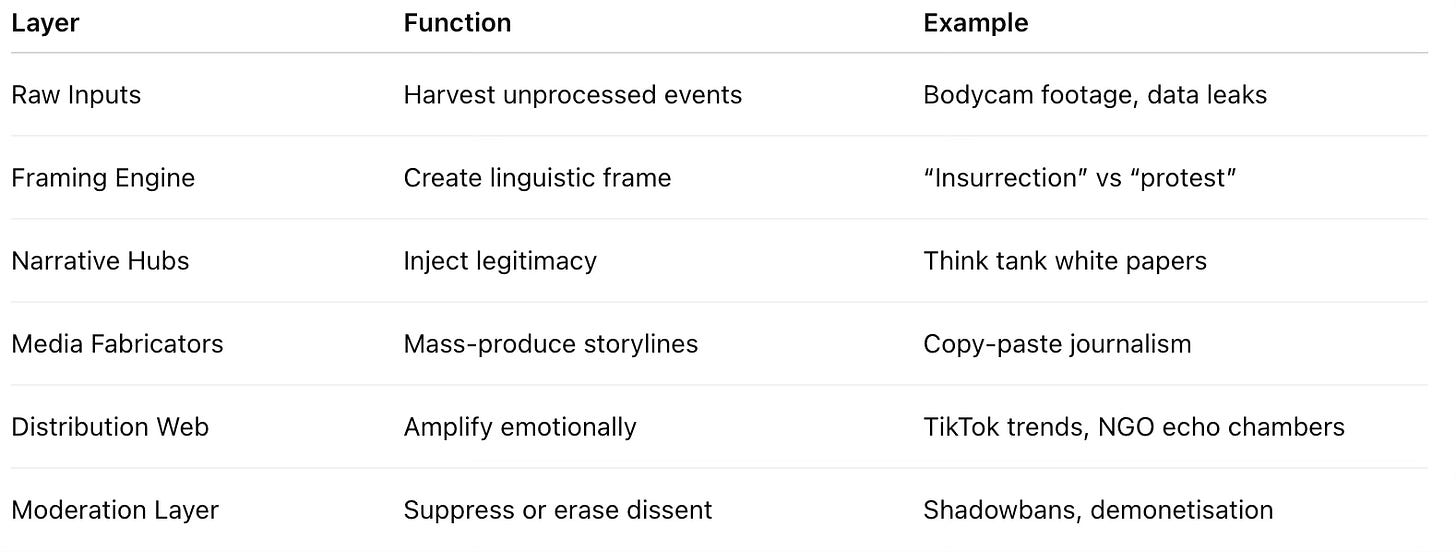
That’s not a conspiracy. That’s a structure. And if you don’t believe it exists, it’s probably because it already shaped your belief.
Case Studies – A Tour Through the Machinery
“Don’t tell me what happened. Tell me who’s allowed to say what happened—and who isn’t.”
Let’s stop speaking in abstractions. You’ve seen the machinery. You’ve felt it, even if you couldn’t name it. Now it’s time to trace its fingerprints across real-world events—those moments you thought you understood, until the frames shattered.
The Narrative Industrial Complex doesn’t deal in lies. It deals in selective emphasis, moral curation, and the aesthetic packaging of ideology as common sense. It can take opposite events and process them through identical pipelines—delivering narratives that are clean, polished, and utterly divergent from what actually happened.
Here’s a guided tour through its greatest hits—left, right, and centre.
🟦 Case Study 1: George Floyd and the Globalisation of American Guilt
The murder of George Floyd wasn’t just an atrocity—it was a trigger event. A single, horrific moment that the Narrative Industrial Complex spun into a global morality play. And within days, every institution—from toothpaste brands to cathedral rectors—was kneeling in submission to a script authored by elite activist-journalist alliances and distributed via algorithmic megaphone.
Suddenly, statues fell. Curricula changed. Police were defunded. None of these were spontaneous. NGOs had playbooks ready. Media outlets deployed racial equity style guides. Governments issued blanket acknowledgments of “systemic racism” without defining the term. Even across the Atlantic, countries like the UK and France—whose own histories and demographics are vastly different—were made to internalise American racial dynamics as gospel.
This wasn’t solidarity. It was narrative colonialism. A universalising script exported via cultural infrastructure and algorithmic reach—flattening historical nuance and local complexity in favour of moral theatrics. And any challenge to this narrative, even those grounded in data or history, was met with the reflexive blade of cancellation.
🟥 Case Study 2: January 6th vs. The Summer of Love
Let’s do a dangerous thing: compare riots.
In the summer of 2020, protests across major U.S. cities included mass arson, looting, federal courthouse attacks, and police murders. The media called it “mostly peaceful.” Even as precincts burned, camera crews stood in front of flames insisting on the righteousness of the cause. Narrative: justified outrage. Subtext: pain has no protocol.
Fast-forward to January 6th, 2021. A mob of MAGA loyalists breached the U.S. Capitol. Stupid, chaotic, performative. One person was shot and killed by law enforcement. That’s it. Yet the narrative machinery spun into overdrive. Overnight, this became “an insurrection”, “a coup attempt”, “the darkest day in American history.”
No equivalence is needed. The point isn’t who was worse. The point is how the same machinery processed two chaotic outbursts and coded one as progress, the other as treason. Why? Because the Narrative Industrial Complex is not reactive—it is ideologically strategic. It has favoured stories and protected targets. It doesn’t tell you what happened. It tells you what it meant, who to fear, who to praise—and above all, what to forget.
🟨 Case Study 3: Syria, Libya, and the Humanitarian Laundering of War
Let’s pan out to geopolitics.
In 2011, the West launched a bombing campaign in Libya under the banner of humanitarian intervention. Same story in Syria, albeit murkier. But the machinery was in full swing. Images of dead children circulated like currency. The White Helmets were praised as saints. NGOs and think tanks saturated the airwaves, pushing for “No Fly Zones” that sounded defensive but were code for air superiority and regime change.
And all of it—every bomb, every rebel faction backed, every chemical weapon accusation—was pre-narrativised. Humanitarian language became war language. CNNand MSNBC ran PSYOPs with better lighting. Tech platforms elevated activist footage, often unverifiable, to emotionally saturate the audience. Then came the kicker: if you questioned any of it, even just asked for proof, you were accused of being pro-Assad, pro-Russia, or worse—a conspiracy theorist.
In this world, doubt is heresy, and heretics are digitally burned.
🟩 Case Study 4: ESG, BlackRock, and the Moral Algorithm
The private sector has been conquered too—through ESG: Environmental, Social, Governance metrics. What began as a vague investor heuristic is now a centralised moral credit system masquerading as corporate ethics. BlackRock, Vanguard, and State Street manage trillions in assets and exert narrative power not through lobbying—but through investment leverage.
Want capital? Then paint your company with the right moral palette. Diversity reports. Climate pledges. Gender equality initiatives. The actual substance? Optional. What matters is alignment. ESG is the NIC's capitalist wing—a mechanism of silent compliance, where even oil companies can be considered “green” if they say the right words, hire the right consultants, and adopt the right hashtags.
And if you question ESG? You’re “anti-progress,” “anti-science,” or “regressive.” Even when the metrics are cooked and the outcomes dystopian.
🕊️ Case Study 5: Ukraine – The Birth of the Blue-Yellow Binary
From the moment Russia invaded Ukraine in 2022, the NIC kicked into wartime overdrive. Flags on profiles. Celebrities reading poetry. Miss Universe contestants demanding air support. But look closely—not at the war, but at how you were told to feel about it.
Coverage from Kyiv was curated to match Western audiences' expectations: resistance, bravery, good vs. evil. Ukrainian voices were elevated only when they fit the script. Azov Battalion? Rebranded. U.S. biological research labs in the region? Taboo. Calls for negotiation? Censored or mocked. Meanwhile, arms packages were announced with corporate fanfare. Peace was an afterthought—escalation was good for business.
Because remember: the NIC doesn’t want resolution. It wants narrative churn. It needs the click-loop, the hero arc, the enemy. Ukraine was never just a battlefield. It became a subscription model for moral clarity. And like all subscription models, the moment you stop paying attention—or start asking the wrong questions—you’re cast out.
⚠️ What Do All These Have in Common?
Each case is different. Each ideology is different. But the structure? Identical. This is narrative manufacturing at scale:
- Crisis → Framing → Activation → Saturation → Enforcement → Forgetting
- Moral binaries override complexity
- Language is weaponised before the facts are in
- Dissent is coded as danger
- Memory is erased or rewritten
The NIC doesn’t care what side you’re on. It only cares that you’re inside its frame. Because once you’re inside, it doesn’t need to win arguments. It just needs to shape the questions.
The New Priesthood – Who Benefits
“Every empire has a priesthood. Ours just wears lanyards, not robes.”
Power doesn’t disappear. It evolves. And in this new age of narrative dominance, the sovereigns are no longer kings or presidents—but curators of meaning. The Narrative Industrial Complex doesn’t just churn content. It consecrates it. It baptises select narratives with moral legitimacy and excommunicates the rest. And behind this machine is a priesthood—an informal but brutally disciplined caste of narrative elites.
These are not Bond villains stroking cats. They’re the moderators, policy fellows, behavioural economists, funded journalists, social entrepreneurs, narrative forecasters, and platform safety consultants. Their power doesn’t come from weapons or elections. It comes from something more sacred in the modern age: moral framing.
Let’s unmask the clergy.
🧠 1. Academia: The Sacred Forge of Moral Language
Every faith needs scripture, and in the NIC, scripture is written in peer-reviewed journals. Academia once pursued truth through debate. Now it manufactures ideological legitimacy. New disciplines are invented not to explore reality, but to redefine it—critical data studies, algorithmic justice, neurodiversity equity frameworks. The language is slippery by design, allowing scholars to moralise complexity while insulating themselves from challenge.
The academic priesthood does three things for the NIC:
- Generates moral vocabulary to guide permissible thought.
- Institutionalises activism under the guise of research.
- Feeds the next generation of policy advisors, DEI consultants, and NGO operatives.
Challenge them, and you’ll be labelled not wrong—but unsafe.
🏛️ 2. Governance Intermediaries and Policy Brokers
Power today doesn’t reside solely in government—it flows through a maze of intermediary institutions: consultancies, global task forces, public-private “initiatives,” and multi-stakeholder platforms.
These entities translate vague moral ambitions into regulatory frameworks, compliance metrics, and narrative templates. You won’t find them on a ballot—but they shape:
- Which narratives are labelled “harmful.”
- Which data sets are “trustworthy.”
- Which futures are “inclusive” enough to be funded or legislated.
They operate in the shadow zone between government and industry, producing white papers, frameworks, and policy toolkits that later become law—without ever being voted on. These intermediaries don’t just interpret reality. They define it.
📰 3. Media Figures and Activist Journalists: The Pulpit Keepers
Forget objectivity. It’s been euthanised, embalmed, and displayed in a museum of dead ideals. Today’s journalists aren’t reporters. They’re licensed interpreters of acceptable truth. You know their names. You’ve seen their bios—always some mix of “truth-teller,” “human rights advocate,” and “disinformation researcher.”
They write not to inform, but to signal. They use phrases like “experts say,” “according to a new study,” or “researchers warn,” not as citations, but as ritual incantations—shortcuts to moral authority. Their job is to interpret the sacred for the masses. They are the modern-day scribes, fluent in the liturgy of harm, trauma, and systemic injustice.
Their power is not in investigation. It’s in consecration. They decide what deserves to be outraged over, what gets buried, and who gets burned at the digital stake.
💻 4. Tech Companies and Trust & Safety Teams: The Algorithmic Inquisitors
Every church needs an enforcer class. For the NIC, that’s Trust & Safety—the most Orwellian euphemism since “Enhanced Interrogation.” These teams don’t enforce truth. They enforce terms of faith—nudging users away from heresy and toward doctrinal compliance.
- “Shadowbanning” becomes “healthy conversation shaping.”
- Deplatforming becomes “community protection.”
- Censorship becomes “content moderation based on partner guidelines.”
These aren’t neutral techies. They are narrative enforcers with backend access, and they execute doctrine invisibly. An idea disappears. A link breaks. A suggestion auto-corrects. You’re not silenced—you’re simply not heard.
👥 5. Strategic Campaigners and Engineered Movements
Gone are the days of spontaneous uprising. Today’s most visible “grassroots” movements often emerge through coordinated strategic campaigns—designed, branded, and often incubated within communication consultancies, activist agencies, and social impact firms.
This doesn’t make them fake. The emotions are real. The causes may be just. But their visibility is engineered.
- Messaging is tested before launch.
- Language is standardised across continents.
- Media appearances are sequenced for maximum saturation.
These campaigns provide the NIC with what it craves most: moral spectacle. Pain, packaged. Outrage, choreographed. Solidarity, templated.
🕳️ The Rabbit Hole Goes Deeper
Even the corporate boardroom has joined the faith. CEOs now double as high priests, issuing statements on every global crisis, no matter how irrelevant to their industry. Why? Because narrative alignment is the new license to operate. Speak the doctrine, or lose market access, social capital, and internal cohesion.
This is the full-blown sacralisation of power. Where speech is blessed or banned. Where morality is a commodity. Where belief itself is brokered.
“Who benefits?” you ask.
The new priesthood benefits.
Not in cash—but in credibility, access, and narrative sovereignty.
And like all priesthoods, they are intolerant of rival gods. The moment you refuse the sacrament—whether that’s a hashtag, a vaccine narrative, a war justification, or a gender discourse—you’re branded a heretic. Or worse, invisible.
Resistance Is Not Reversal – What Now?
“You can’t kill the machine by screaming at it. It thrives on the sound.”
Let’s be clear about something: resistance is not romantic. It’s not a meme, a slogan, or a cute new Substack with a black-and-white logo. You don’t get to opt out of the Narrative Industrial Complex with a declaration. You were born into it. You speak its language. You filter your outrage through its aesthetics. You are—whether you like it or not—a narrative native.
So if you came here for an easy blueprint on how to “fight back,” I have bad news: most forms of resistance are already pre-narrativised. The machine expected your rebellion before you did. It has prototypes for you. Conspiracy theorist. Contrarian. Alt-journalist. Shadow academic. It has already rehearsed your protest and built the backlash. You were cast in the play before you even stepped onstage.
Because the NIC is not just a propaganda network. It is a metastructure of meaning. It eats critique. It feeds on resistance. It recycles dissent into brand equity for itself. Spotify vs Joe Rogan? Narrative. Twitter Files? Narrative. New populist podcasts railing against the mainstream? Also narrative. Every act of defiance is quickly metabolised into a marketable archetype. And then it’s sold.
🧠 There Is No Outside—But There Is Awareness
If there’s no outside to this machine, what’s left?
Narrative literacy. Not escape. Not purity. Just awareness. The ability to see the frame before you react to it. To ask whythis story, why now, and who gains. It’s not enough to be sceptical. You must become structurally aware.
- When you see a protest video, ask how it got to you, not just what it shows.
- When you hear a new moral term—“safetyism,” “equity harm,” “algorithmic bias”—ask who coined it and who benefits from its spread.
- When your outrage flares, pause. Track the trigger. Identify the architecture behind the emotion.
In the narrative economy, your attention is currency, and your moral reaction is a commodity. True resistance is not to shout louder. It’s to refuse to be used.
⚖️ The Grey Zone: Where Real Thinking Begins
The most subversive act in the NIC isn’t to choose a side. It’s to walk the moral grey zone. To not be easily legible. To not speak in the pre-approved cadences of either side. To say:
“I don’t know. I need more evidence. I reject your frame.”
That is anathema to the system. It thrives on binaries. If you reject both, you’re not just a threat—you’re unreadable. And unreadable people don’t feed the machine. They jam it.
This is the real battlefield now. Not facts versus lies. Not left versus right. But legibility versus opacity. Those who can be labelled are useful. Those who can’t are dangerous.
🛠️ Build Quiet. Speak Rarely. Think Like a Smuggler.
So what do we do?
- Don’t build echo chambers. Build quiet communities of pattern recognition. Teach others to spot narrative manipulations the way pilots are taught to read a cockpit.
- Speak rarely, but when you do, speak surgically. Don’t waste energy on performative rage. The NIC feeds on that. Precision undermines it.
- Think like a smuggler. Hide insight in unexpected forms. Layer truth inside fiction. Embed complexity inside humour. Make the message slippery to the system’s categorisation.
You will not dismantle this complex by frontal assault. You won’t out-shout it. You won’t out-viral it. But you can out-think it. You can refuse to play the assigned role. You can starve it of easy enemies.
“The first freedom is to see the strings. The second is to stop dancing to them.”