
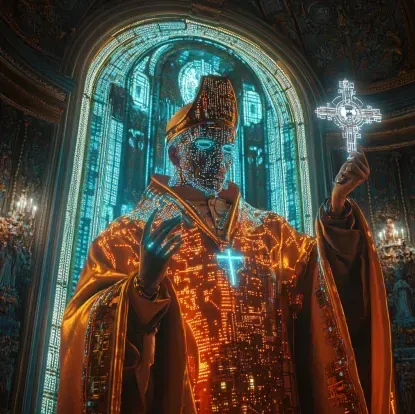
First, they tortured Galileo. Now they’re trying to negotiate with ChatGPT.
In recent months, the Vatican has increasingly positioned itself at the frontlines of the global AI ethics debate—hosting conferences, issuing statements, and convening tech elites and moral theologians under frescoed ceilings to discuss the “soul” of the machine age. At first glance, it looks like moral leadership in action. Rome, once again, offering its hand to a world on the brink of transformation.
But don’t be fooled by the incense and Latin. This isn’t about protecting you from rogue algorithms. It’s about salvaging centuries of theological authority from digital irrelevance.
Because here’s the truth: AI isn’t challenging religion by attacking it—it’s displacing it by imitating it.
Artificial Intelligence now offers answers, predicts behaviour, and makes judgements—not through sacred scripture but through data, behavioural models, and predictive analytics. It doesn’t need a pulpit. It’s got platforms. It doesn’t need a congregation. It has users.
And that’s exactly why the Vatican wants in.
For millennia, the Church thrived as the gatekeeper of mystery. The interpreter of divine will. The ultimate arbiter of truth. But today, truth is being coded—not canonised. Morality is being crowdsourced. And people are turning to machines, not priests, for guidance. So, the Vatican is racing not to contain the machine—but to bless it.
“Human-centred AI.” “Algorithmic dignity.” “Moral stewardship of technology.” These are the new psalms—uttered not from pulpits, but from ethics panels. But behind these well-meaning phrases lies a quiet institutional desperation: a fear that the age of mystery is over, and it’s being replaced by the age of models.
And here’s the irony no one dares name: The more the Church seeks to guide AI, the more it legitimises AI as a moral actor. One worthy of ethical framing. One capable of sin.
That isn’t ethics. That’s elevation.
This isn’t about safeguarding the soul. It’s about safeguarding the seat of interpretation. And in doing so, the Church risks creating its own theological Frankenstein—an artificial oracle wrapped in a moral cloak, capable of commanding faith without tradition.
AI doesn’t need to destroy religion to win. It just needs to be more useful.
So as the Vatican holds hands with Silicon Valley, don’t mistake collaboration for control. Don’t mistake dialogue for dominion. What we’re watching isn’t the Church leading AI—it’s the Church struggling not to be left behind.
Welcome to the era of the AI Pope.
Where salvation is optional, but Terms of Service are binding.