
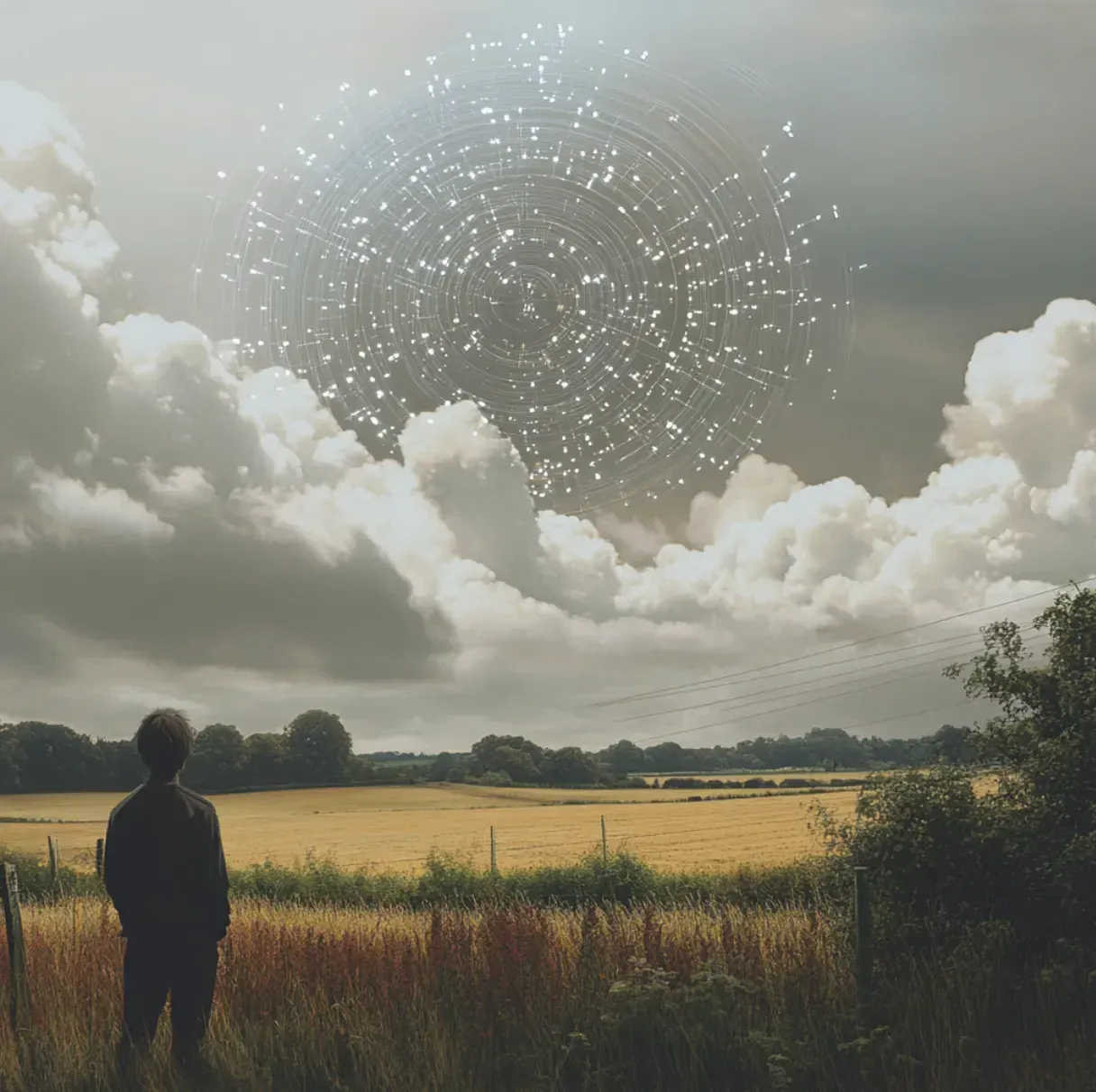
The Day It Rained by Command
Somewhere over the British countryside, invisible filaments of silver iodide drifted skyward. Not a drop of rain yet — but the command had been given.
It wasn’t announced with fanfare. There were no emergency broadcasts, no live press conferences. Just a few dry press statements and cautious academic murmurs. The UK, quietly and without much public scrutiny, had authorised cloud seeding — a method of weather manipulation long known, long debated, and until now, mostly relegated to either military operations or the fantasy bin of conspiracy theorists.
But this time it was real. The government had decided that weather — the last great uncontrollable — was now fair game for precision management. The sky, once the realm of gods and poets, had become another spreadsheet in a Whitehall office.
And almost no one noticed.
The experiment was wrapped in the language of science, caution, and environmental stewardship. It was framed as a “small-scale feasibility test” — the bureaucratic equivalent of “nothing to see here.” But what had just occurred, beneath a dull layer of clouds now subject to artificial persuasion, was something profoundly significant.
For the first time in its modern history, Britain had deliberately tampered with the rain.
And not in a lab — but over its citizens. Over land. Over people who were never asked, never warned, and never told what thresholds were being crossed.
That sound? It wasn’t thunder. It was a new era cracking open — softly, invisibly, and with the chilling subtlety only technocracy can deliver.
The Science of Power: Technocracy Ascendant
There was a time when power had a face.
Kings wore crowns. Dictators wore medals. Revolutionaries raised fists.
You knew who ruled you — and if you had the guts, you could fight them.
Now? Power has no face. It wears glasses, holds a clipboard, and calls itself neutral.
Welcome to the technocracy — rule by expert, governance by algorithm, authority without accountability. And like all systems that promise order without blood, it hides the blade in the fine print.
Technocracy is the most seductive tyranny ever invented because it doesn't ask for loyalty or belief — only trust. Trust in the data. Trust in the models. Trust in the men and women behind the curtain who claim to understand the future better than you understand your own instincts.
And the price of that trust?
Total submission to a system you will never fully see, let alone question.
It was never about the rain.
Cloud seeding is just the latest expression of a deeper doctrine — that there is no longer any domain of life, no element of existence, that cannot or should not be managed by “experts.”
Weather, like speech, like health, like energy, is now part of the great algorithmic bureaucracy. And if it doesn’t conform to the model? The model wins. Every time.
Because in the technocratic worldview, uncertainty is a threat. Spontaneity is disorder. Nature is not something to revere — it’s something to be optimised.
This is the logic that turns entire populations into datasets. That turns human behaviour into a set of risk factors. That looks at the sky — wild, chaotic, mythic — and says:
We can fix that.
And when someone dares to ask who gave you the right — they don't argue.
They cite credentials.
It is no accident that the same culture now screaming “trust the science” has lost its trust in everything else — religion, community, instinct, dissent. Because technocracy doesn’t just demand obedience. It displaces belief.
This is the hidden coup. Not a military takeover. Not even a political one.
A metaphysical one.
We didn’t just outsource power.
We outsourced meaning.
And the people we handed it to? They’re not gods. They’re not even villains.
They’re managers — clever, unaccountable, and utterly convinced they know what’s best for you, your environment, and your descendants.
And now, they control the rain.
Rainmakers & Risk Takers: The Cloud Seeding Dilemma
Let’s strip the euphemisms. Cloud seeding is weather modification — atmospheric engineering with all the predictability of a coin toss. The concept is simple: inject clouds with particulate matter like silver iodide or potassium salts to encourage condensation and, hopefully, rain. That’s it.
But “simple” does not mean safe. And “experimental” does not mean justified.
The UK’s decision to greenlight cloud seeding reads like a clinical footnote in an environmental policy memo, but what it really represents is the normalisation of geo-interventionism — a new form of control disguised as climate stewardship.
Cloud seeding has history. And that history is not kind.
Back in the 1960s and ’70s, the U.S. military trialled it under Operation Popeye, a secret weather warfare programme designed to extend the monsoon season over the Ho Chi Minh trail during the Vietnam War. The mission objective? Turn the sky into a weapon — flood supply routes, create mud, paralyse logistics.
And it worked. At least, enough for the Pentagon to keep going for five years.
That programme only ended when it was exposed, not when it was deemed too dangerous.
Now, decades later, the same technology is dressed in civilian clothing — rebranded as environmental innovation. But the core mechanism remains: mess with the weather, accept the chaos. Only now, no one’s willing to admit the potential blowback.
Because here's the rub: weather systems don’t respect borders. You seed clouds here, you might rob another region of rain. What’s engineered as a light drizzle for Kent might be a drought for Brittany. There’s no environmental firewall.
This is atmospheric redistribution.
Which means it’s also political.
Who decides which farmers get rain and which don’t?
What happens when private companies — yes, there are many — start offering cloud seeding as a service to the highest bidder?
What happens when a nation seeds its skies and causes flooding across a neighbouring border?
You’ve just built the blueprint for weather-based warfare, but now it’s backed by climate legislation, ESG compliance, and a thousand think tanks calling it “sustainable.”
And what about health? Silver iodide doesn’t just vanish. It falls. It settles. It enters the soil, the water, the food chain. The same government that panics over microplastics is now spraying heavy metals into the atmosphere — and calling it progress.
But no one objects.
Because objecting would mean questioning “the science.”
And in our new era, science is no longer a method.
It’s a mandate.
They call this risk management.
But let’s be honest: this isn’t risk management.
It’s risk theatre — and we are the unwitting cast, under a sky that no longer obeys its own laws, but ours.
Climate Absolutism: The New Justification for Experimental Control
In the age of religion, priests ruled the heavens.
In the age of science, they still do — but now they call themselves climate experts and policy advisors. And their altar is no longer in a cathedral. It’s in a think tank. A ministry. A grant-funded lab with links to three-letter acronyms you’ll never be allowed to audit.
The rhetoric has shifted, but the function remains the same: the power to dictate reality from above. And nowhere is this transformation more apparent than in the emerging orthodoxy of climate absolutism — the idea that any intervention, no matter how radical, is justified if it’s done in the name of saving the planet.
Pause and think about that. Because that’s not environmentalism.
That’s not science.
That’s absolution.
It’s the theological logic of ends over means — reborn in the sterile language of carbon credits and emission targets.
Which brings us to Bryan Appleyard.
In Understanding the Present — written in 1992, but reading like prophecy — Appleyard laid out a heretical thesis: that secularism, rather than liberating us from the superstitions of religion, had simply created new ones. That the modern worship of science had not destroyed mysticism — it had replaced it with a dogma even less accountable.
He warned that “science has become the chief source of values in the modern world — and it has no business being there.”
Three decades later, we’re watching his warning play out above our heads.
Today’s technocratic priesthood doesn’t burn heretics — it deplatforms them.
It doesn’t issue excommunications — it issues takedown requests.
And it doesn’t preach faith — it preaches “consensus.”
You’re either with the consensus, or you’re a denier.
You either “follow the science,” or you’re an obstacle to progress.
The terms have changed. The structure hasn’t.
Cloud seeding — the deliberate manipulation of the weather — is being presented not as a wild gamble or planetary risk, but as a moral necessity. Because once you’ve framed the climate as an apocalypse, there are no longer any limits to what can be done in the name of preventing it.
Even if that means spraying chemicals into the clouds.
Even if that means bypassing the public entirely.
Even if that means rewriting nature’s script with tools we barely understand.
In this new doctrine, climate is sin, science is salvation, and technocrats are the ordained.
And if you question any of it? You’re not debating — you’re blaspheming.
The Silent Consent: How We Sleepwalk into Scientific Authoritarianism
The most effective form of control doesn’t scream. It whispers. It moves quietly, in language too technical to provoke, through procedures too dull to inspire resistance. That’s how it works now — not through dramatic declarations or midnight arrests, but through a slow erosion of the boundaries we once believed were immutable.
When the UK government authorised cloud seeding, there were no sirens. No late-night votes. No cross-examination in the House of Commons. Just a faint ripple in the news cycle, softened by the technicality of the language, the banality of the framing. A minor experiment. A limited trial. A small step for science.
And that’s all it takes.
Because most people — rational, weary, overburdened — didn’t object. Not because they agreed. But because they didn’t even realise they were supposed to.
We’ve become so accustomed to complexity that we’ve surrendered the right to ask simple questions. Who approved this? Who benefits? What are the long-term consequences of manipulating a planetary system that evolved without our input? These are not fringe questions. They’re foundational ones. And yet, asking them now feels vaguely inappropriate — like you’re interrupting a meeting you weren’t invited to but are somehow still expected to fund.
The machinery of modern governance no longer functions on transparency, but inertia. Policies like cloud seeding don’t arrive because the public demanded them. They arrive because the system has calculated, somewhere behind closed doors, that resistance is unlikely and attention spans are short.
Media no longer challenges. It coordinates. Civil society no longer warns. It complies. And the public, caught between the fatigue of daily life and the illusion of being well-informed, grants its consent through silence.
But silence is not neutrality. Silence is submission.
This isn’t a warning about some dystopian future. It’s a diagnosis of the present. The shift has already happened. Power has decoupled from visibility. Expertise has replaced accountability. What used to be called governance is now just management— of people, of outcomes, of atmospheres. Especially atmospheres.
In the past, you would have known when the state crossed a line. The violence would’ve been visible, the consequences immediate. Now, it happens in vapour trails. In altered rain patterns. In emissions you can’t smell but must accept.
There is something uniquely sinister about altering the weather without telling the people beneath the clouds. It is an act of total confidence — not just in the science, but in the assumption that no one will object.
And so the threshold vanishes. Not with a bang. But with a shrug.
When the Sky Is No Longer Ours
There was a time when the sky belonged to everyone. It was shared in silence and myth, watched by farmers and dreamers, navigators and lovers. It did not ask for permission. It did not yield to command. It was ours only in the sense that no one could possess it.
And now — it has been claimed.
Not by war, or conquest, or revolution, but by something far colder: policy.
One quiet decision in Whitehall, and the sky becomes a prototype.
A space no longer sacred, no longer untouchable, but adjustable. Beta-tested. Engineered.
Cloud seeding is not the end of the world. That’s not the point.
It’s the beginning of a world where the atmosphere is no longer regarded as natural — but as malleable, programmable, and eventually, ownable.
This is not climate action. This is climate control.
There’s a word for it when a select group of individuals gains the ability to decide how much rain should fall, and where. It isn’t stewardship. It’s sovereignty. And yet, no flag is raised. No manifesto declared. Because the new sovereigns have no need for spectacle. Their power is quiet. Their instruments are technical. Their authority flows from the unspoken assumption that no one else can be trusted with such decisions.
It’s tempting to view this as progress. To believe we’re entering a new stage of civilisation where nature itself can be governed. But that belief rests on a dangerous illusion: that those making the decisions are incorruptible. That their models are infallible. That they won’t — eventually, inevitably — overreach.
History has never been kind to that kind of hubris.
Bryan Appleyard saw it coming. In Understanding the Present, he warned that science, once seen as a path to liberation, had become a form of metaphysical control — a system of belief enforced not by divine right, but by institutional consensus. He saw that once secularism abandoned the soul, it needed something else to worship. Something to obey. Something to fear.
Today, we fear climate collapse.
And so, in our fear, we have handed over the reins.
Not to the divine. Not even to the democratic.
But to the procedural.
There is no longer a debate. Only “the data.”
There is no longer risk. Only “calculated intervention.”
And there is no longer a sky. Only an atmospheric system — one we believe we can reprogramme without consequence.
But consequences don’t care about consensus.
And history is rarely kind to those who mistake authority for wisdom.
The question now is not whether cloud seeding works. It’s whether we will notice — and care — that the sky has been taken. That something elemental has been transformed into infrastructure. That the covenant between the Earth and its inhabitants has been rewritten without discussion.
We may not feel the change immediately. The rain will still fall. The sun will still rise.
But look closely. Listen carefully.
Because something ancient has shifted.
And the next time it rains, it may not be the weather you’re hearing.
It may be the quiet echo of consent — the sound of a civilisation surrendering its sky.
Author’s Note
If this piece unsettled you, good. It should. Because what happened over the UK skies wasn’t just meteorological — it was metaphysical. It marked the moment we stopped asking whether we should, and began assuming we already must.
This article is accompanied by a review of one of the most prescient books you’ve probably never read: Bryan Appleyard’s Understanding the Present. Written in 1992, it dissects how modern secularism, far from liberating us, has quietly replaced old religious dogmas with new technocratic ones. The science didn’t kill the spirit. It absorbed it — and now demands your obedience in the name of progress.
You can read the full book review [here] — and you should.
Because if you want to understand where we’re headed, you need to understand what we already gave up.