
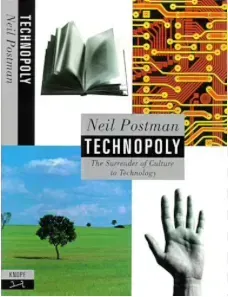
⚙️ The book that explains why the machines didn’t take over — we just stopped resisting
❝ Quote That Cuts ❞
“Technological change is not additive; it is ecological. A new technology does not merely add something; it changes everything.”
— Neil Postman, Technopoly
⚡ Why This Book
Because Sky Lords essay wasn’t just about climate intervention — it was about belief. Belief in the algorithm. Belief in expertise. Belief in the machinery of modernity as not just useful, but unquestionable.
Postman takes that belief system apart brick by brick.
Published in 1992 — the same year as Appleyard’s Understanding the Present — Technopoly is its American cousin. Where Appleyard exposed science as a new metaphysics, Postman maps how technology became the dominant religion of the modern West. And like any good religion, it doesn’t ask for understanding. It demands faith.
If you want to understand why geoengineering, AI governance, climate panic, and even digital identity are all treated as inevitabilities — this is the intellectual blueprint.
📚 What It’s About
Postman’s argument is razor-edged: technology isn’t just a tool we use — it’s a force that reshapes the very conditions of thought, culture, and power.
He divides societies into three categories:
- Tool-using cultures, where tech supports religious or political ideals
- Technocracies, where tech begins to dominate social structure but still competes with older moral systems
- And finally, Technopolies — cultures where technology is not one way to live, but the only way.
A Technopoly no longer asks: Should we do this?
It only asks: Can we?
In a Technopoly, efficiency replaces ethics.
Data replaces wisdom.
And expertise becomes the only valid form of authority — even when it’s dead wrong.
Sound familiar?
🔍 Why It Matters Now
Let’s count the ways.
- The UK just authorised cloud seeding, a form of state-sanctioned weather control, with zero public debate. Because… “science.”
- The EU is rolling out AI legislation to shape what machines should do — but with barely a whisper about what people shouldn’t allow.
- Governments across the West are locking in digital identity regimes not through legislation, but through terms of service and slow compliance creep.
- “Climate solutions” now include proposals to dim the sun — and if you oppose them, you’re anti-science, anti-progress, anti-human.
What Postman warned us about wasn’t that technology would fail.
He warned that it would succeed too well — and in doing so, make it impossible to imagine any other kind of life.
In a Technopoly, problems don’t require moral responses.
They require engineering teams.
You no longer ask how to live well.
You just optimise the inputs.
🧨 Key Takeaway
We didn’t lose control.
We handed it over —
to people who promised convenience
and never asked for consent.
🛠️ Useful If You’re Thinking About…
- Why public debate has disappeared from climate tech, AI, and biotech
- How crisis narratives are used to justify permanent innovation
- The cult of the expert in democratic societies
- Why resisting new technology now feels like blasphemy
- How infrastructure becomes ideology
- Why “progress” is no longer something you vote on — just something that happens to you
🧱 Read This If You Liked:
- Bryan Appleyard – Understanding the Present
- James Bridle – Ways of Being
- Evgeny Morozov – To Save Everything, Click Here
- C.S. Lewis – That Hideous Strength
- Any time you feel you’re being nudged, managed, or upgraded — without ever being asked
📎 Contextual Link to Sky Lords
The decision to interfere with the weather wasn’t just scientific.
It was civilisational.
It showed — without apology — that we now live inside a Technopoly.
A system where control is sacred, and resistance is inefficiency.
Postman explains how we got here.
Not through conspiracy, but through a cultural mutation.
A slow surrender to systems we didn’t build — but now can’t seem to live without.
🔗 Where to Find It
Widely available — but rarely taught.
You won’t find it on ESG reading lists.
Too dangerous. Too honest.