
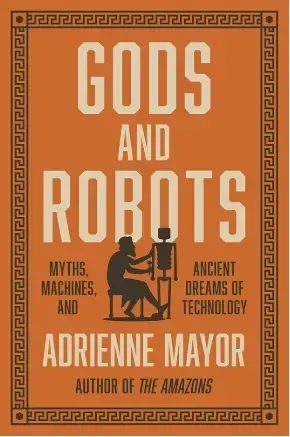
❝ Quote That Cuts ❞
The earliest imaginings of artificial life were not modern—they were mythic.”
— Adrienne Mayor, Gods and Robots
⚡ Why This Book
Because the idea of building intelligent machines didn’t begin with Silicon Valley.
It began with the gods.
Mayor’s Gods and Robots is a blistering reminder that our obsession with artificial intelligence, automation, and bioengineering is not the product of a rational age—but the reawakening of a mythical one. Drawing from Greek, Roman, and Near Eastern mythology, Mayor uncovers a forgotten archive of artificial lifeforms, self-moving machines, synthetic servants, and techno-deities that mirror today’s headlines with uncanny precision.
If The AI Pope exposed how spiritual institutions are trying to bless the machine age, Gods and Robots shows that the machine age was always spiritual.
📚 What It’s About
Mayor takes us on a sweeping journey through myth and ancient storytelling, where gods like Hephaestus and Daedalus were early prototypes for modern engineers, and golden automatons, self-replicating machines, and “living statues” populated the imagination of pre-industrial societies.
This isn’t literary fluff—it’s technological anthropology.
Mayor doesn’t just point out metaphors—she documents how ancient texts preciselydescribe mechanisms that sound eerily like AI:
- Talos, the bronze giant who patrolled Crete, prefiguring the logic of autonomous drones
- Pandora, an artificial woman created to punish mankind, mirroring modern anxieties around synthetic life and gendered machines
- Hephaestus’s robotic servants, endowed with voice, movement, and knowledge
- And the story of Pygmalion, a sculptor whose statue came to life—not with code, but with divine spark
Mayor’s central thesis is devastatingly elegant: modernity didn’t invent artificial intelligence—it remembered it. And the ancients, in their myths, had already grasped what we pretend is novel: that giving life to artificial beings inevitably raises questions not of progress, but of power, control, hubris, and consequence.
🔍 Why It Matters Now
Because the AI discourse is suffocating under a thick fog of rationalist branding and technical jargon.
We’re told it’s about productivity. Efficiency. Innovation.
But read between the lines and you’ll see the return of something far older: ritual. Creation myths. Magical thinking.
Why else do governments speak of “guardrails” and “safe development” as if they’re handling a sacred flame?
Why do corporations anthropomorphise their algorithms—calling them “agents,” “minds,” or “partners”?
Why is the Vatican hosting conferences on the ethics of machines—as though ethics could be coded?
Because we’ve stopped thinking of AI as a tool.
We’ve started thinking of it as a being.
And once that shift happens, you’re no longer in the realm of engineering.
You’re in the realm of myth.
Mayor’s work explodes the notion that we’re in uncharted territory.
On the contrary—we’re repeating a story humanity has told for thousands of years.
Only this time, the stakes aren’t mythic. They’re real.
🧨 Key Takeaway
The future we’re building isn’t new.
It’s the reboot of an ancient epic—
Only this time, the gods are us.
And we’re not ready for the reckoning.
🛠️ Useful If You’re Thinking About…
- Why AI and robotics often feel religious, not rational
- How mythology informs modern ethics
- What Pandora really symbolised — and how she still haunts gendered AI
- The ancient precursors to cybernetics and artificial life
- Why creation myths are reappearing in policy and engineering spaces
- How hubris around invention has always led to collapse
- Why the future might look more Homeric than post-human
🧱 Read This If You Liked:
The AI Pope – Essay
Bryan Appleyard – Understanding the Present
Neil Postman – Technopoly
David F. Noble – The Religion of Technology
James Bridle – Ways of Being
Mary Shelley – Frankenstein
Yuval Harari – Homo Deus (but with more scholarship and fewer TEDisms)
Any time you feel like the tech world is staging a reboot of The Iliad with GPUs instead of swords.
📎 Contextual Link to The AI Pope
When Pope Francis talks about the “dignity” of AI, and when CEOs gather at Davos to warn about artificial general intelligence while simultaneously investing billions into it, they are not discussing tools.
They are negotiating with myths.
Gods and Robots explains the shape and substance of those myths.
Not as fantasy — but as the architecture of modern belief.
It makes clear: we are not rational actors in a technological world.
We are storytellers, caught in our own fictions.
And those fictions now write code.
🔗 Where to Find It
Published by Princeton University Press.
Still criminally underread.
The kind of book no tech executive will quote —
because it dismantles the religion they’re building.